Seismic Array Source Imaging
We answer fundamental questions about the physics of earthquake ruptures — initiation, complex propagation, and final arrest — through high-resolution, robust observations. Numerical models predict rich rupture behavior, but observational constraints have long been limited by resolution. Dense seismic arrays let us trace high-frequency radiation by back-tracing the seismic waves they record, tracking the strongest zones of rupture radiation in space and time.
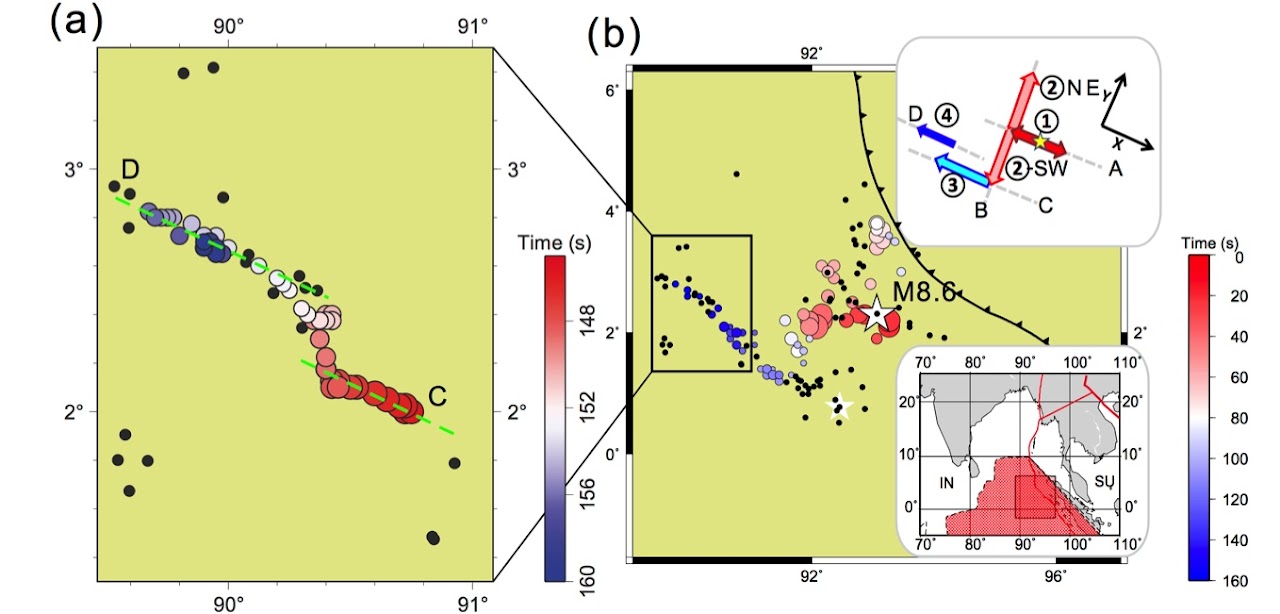
Case study — 2012 off-Sumatra M8.6. Back-projection revealed a remarkably complex rupture on four orthogonally oriented fault planes. The rupture branched onto faults under compressional stress — challenging conventional dynamic-clamping theory — and jumped a ~20 km offset between parallel segments, far larger than the ≤5 km steps typical of California faults.
High-resolution MUSIC imaging
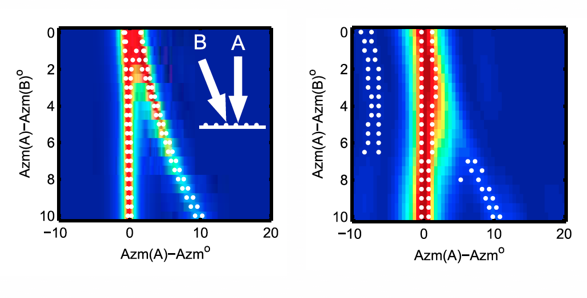
Standard back-projection uses beamforming, which has limited resolution when multiple sources radiate simultaneously. We introduced the MUltiple SIgnal Classification (MUSIC) algorithm into back-projection (Schmidt, 1986; Meng et al., GRL 2011) and made it practical for non-stationary seismic signals using multitaper cross-spectrum estimates (Thomson, 2000). MUSIC-enhanced back-projection yields sharper images of the rupture process (Meng et al., JGR 2012) and can separate sources with azimuth separation as small as 3°.
Reference-window strategy (the “swimming artifact”)
A well-known problem in back-projection is the “swimming artifact” — systematic transients that migrate across the image toward the receiver array, degrading confidence in source details. The artifact arises because earthquake waveforms are impulsive and non-stationary, whereas conventional back-projection assumes stationary signals. By replacing the conventional “absolute window” with a “reference window” in the sliding-window analysis, we mitigate the swimming artifact (Meng et al., EPS 2013) without sacrificing resolution.
Slowness calibration
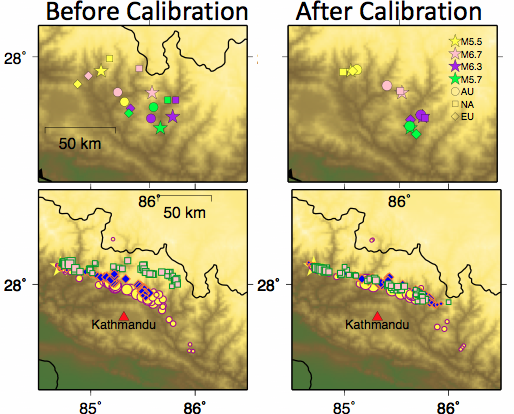
Different arrays can image the same earthquake differently, largely because of array-specific P-wave travel-time errors from 3-D Earth structure. We proposed slowness calibration (Meng et al., 2016) to reconcile them. Beyond aligning the first arrival to the cataloged hypocenter, we add a slowness (ray-parameter) correction — the spatial derivative of travel time with source location at each station — calibrated using aftershock catalogs. This markedly improves the consistency of back-projection across globally distributed arrays.
3-D back-projection for deep earthquakes
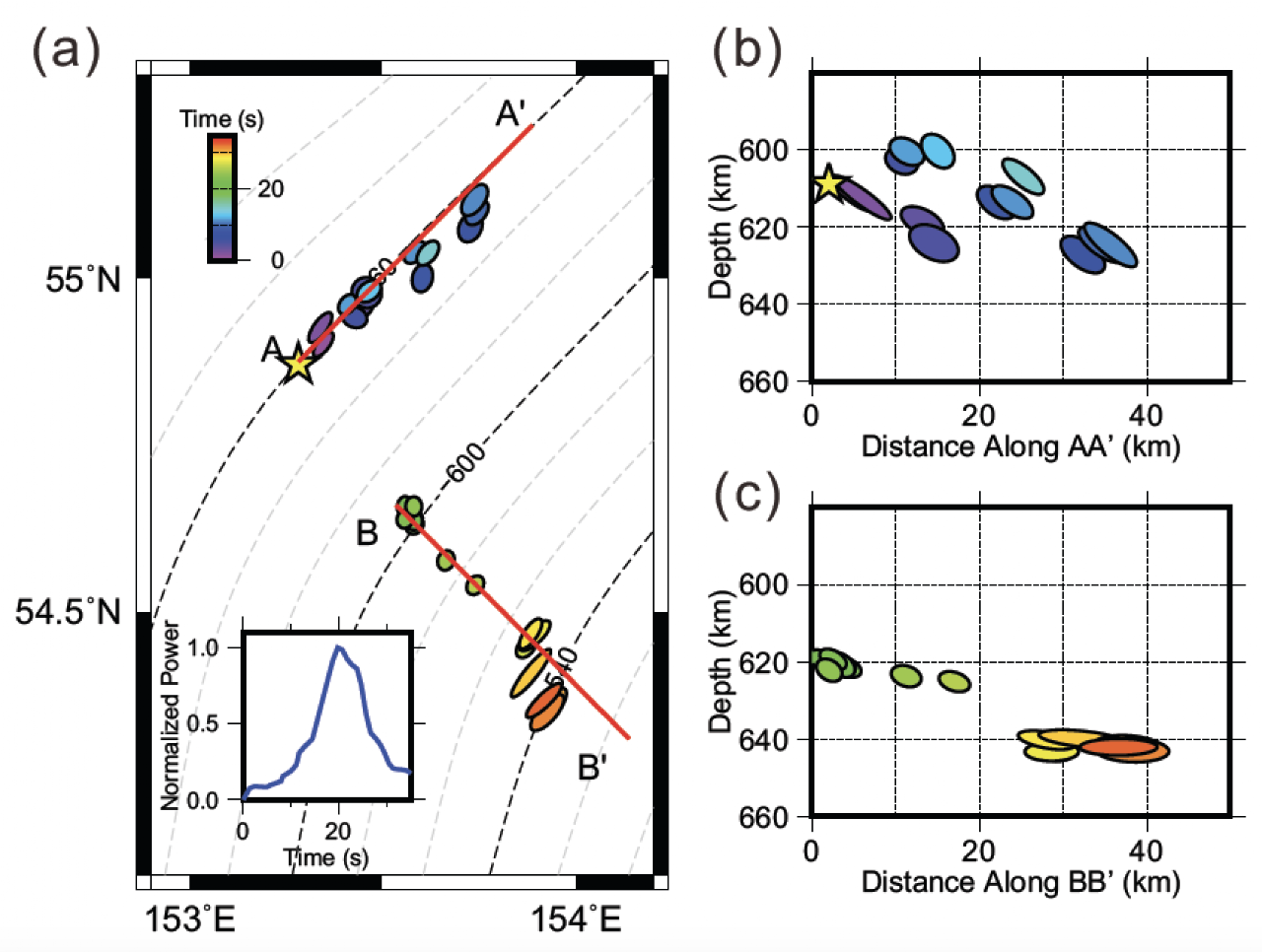
For deep-focus earthquakes, whose fault planes are poorly defined, we developed 3-D back-projection (3DBP). Because teleseismic rays are nearly vertical, standard back-projection has good horizontal but poor depth resolution. 3DBP combines P and pP phases, whose ray paths intersect in space, to recover depth. Applied to the 2013 Okhotsk earthquake (Mw 8.3) — the largest deep-focus event ever recorded — 3DBP shows a predominantly horizontal N–S rupture whose focal depth increases southward, consistent with cascading failure along sub-parallel horizontal planes in an en-echelon pattern.
Physical insights from recent large earthquakes
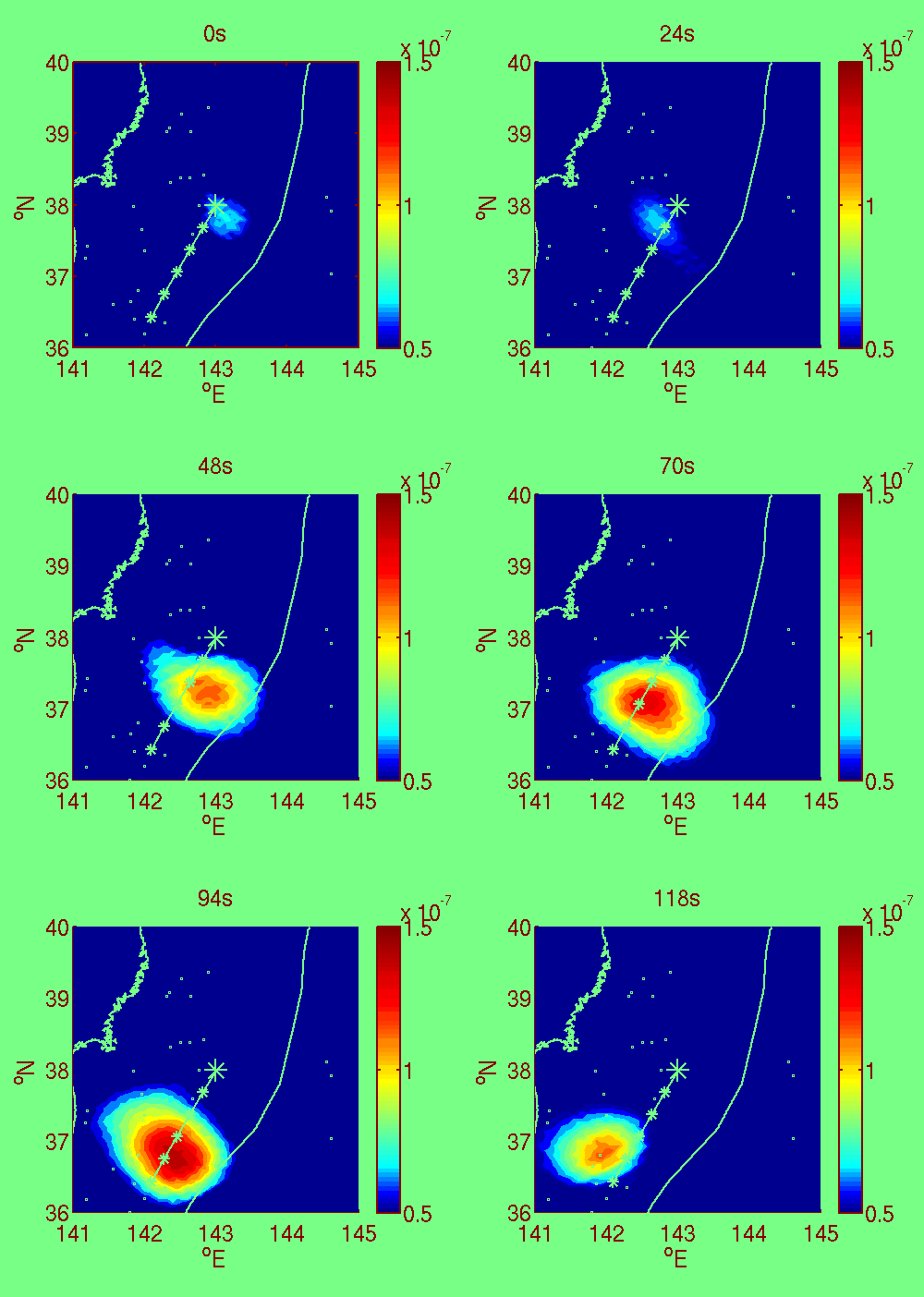
Across many events, source imaging reveals rupture physics. In Tohoku-Oki, peak low-frequency slip lies up-dip of the hypocenter while high-frequency radiation comes from the deeper megathrust, consistent with small brittle asperities embedded in a ductile matrix. In Haiti, two high-frequency subevents at the ends of the geodetic slip mark stopping phases. In off-Sumatra, the rupture branched onto compressional faults, challenging dynamic-clamping ideas. In Okhotsk, olivine-to-spinel phase transformation and thermal-runaway shear instability appear to control different rupture segments. Additional studies (Iquique, Gorkha, Tajikistan, Illapel) show how ruptures interact with geometric barriers, narrow into confined zones, and split around asperities.